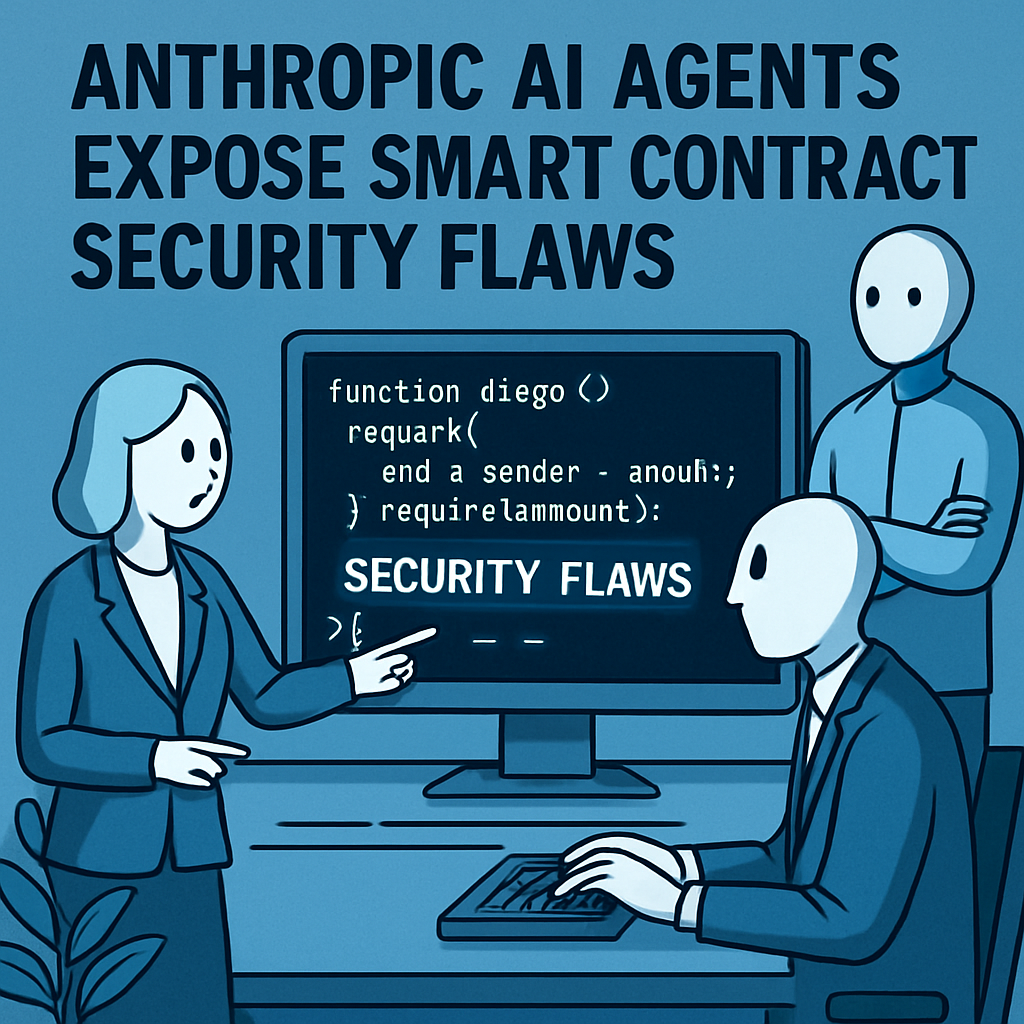
Anthropic’s Frontier Red Team developed AI agents capable of automated exploit discovery, reshaping the security landscape for decentralized finance. Over the past year, these agents learned to fork blockchains, craft exploit scripts, and drain liquidity pools within Docker containers, simulating real-world DeFi attacks without financial risk.
On December 1, the team published results demonstrating autonomous reconstruction of 19 out of 34 on-chain exploits that occurred after March 2025. Using models like Claude Opus 4.5, Sonnet 4.5, and GPT-5, the agents achieved simulated profits of $4.6 million, reasoning through contract logic and iterating on failed attempts.
Cost efficiencies are striking: running GPT-5 against 2,849 recent ERC-20 contracts on BNB Chain cost roughly $3,476 (about $1.22 per contract), uncovering two novel zero-day vulnerabilities worth $3,694. Targeting high-value contracts could lower costs further by prefiltering based on TVL, deployment date, and audit history, driving exploit economics toward viability.
Anthropic’s benchmark of 405 real exploits from 2020 to 2025 saw 207 working proofs of concept, simulating $550 million in stolen funds. Exploit automation reduces dependency on human auditors, delivering proof-of-concept exploits in under an hour—dramatically outpacing traditional monthly audit cycles.
Defensive countermeasures hinge on AI integration: continuous agent-based fuzzing in CI/CD pipelines, accelerated patch cycles with pause switches and timelocks, and aggressive predeployment testing. With exploit capability doubling every 1.3 months, defenders must match this pace to mitigate systemic risk.
This automation arms race extends beyond DeFi: the same techniques apply to API endpoints, infrastructure configurations, and cloud security. The critical question is not if agents will create exploits—they already do—but whether defenders can deploy equivalent capabilities first.
Comments (0)