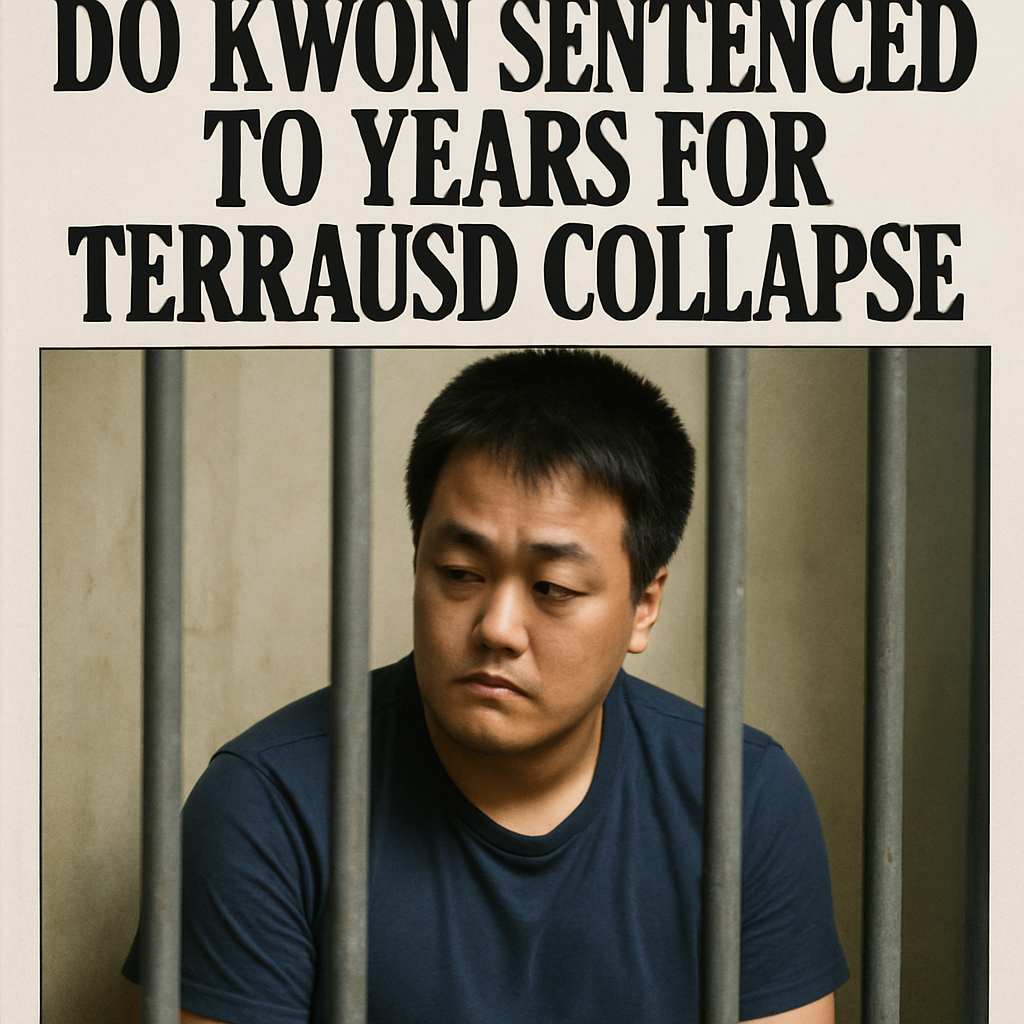
Terraform Labs co-founder Do Kwon has been handed a 15-year sentence by a U.S. federal court after admitting to fraud charges spanning commodities, securities and wire communications. The judgment, delivered by Judge Paul Engelmayer of the Southern District of New York, cited the “epic, generational scale” of Kwon’s deception, which collapsed the Terra USD (UST) stablecoin and its sister token Luna in May 2022.
The court documents reveal that Kwon’s operation involved an intricate design of smart contracts engineered to maintain UST’s $1 peg through algorithmic minting and burning of Luna. Despite efforts to shore up the ecosystem with $3.5 billion in bitcoin reserves, market forces and a cascading loss of confidence triggered UST’s descent to $0.09, erasing roughly $40 billion in value within days.
Following the collapse, investors worldwide faced massive losses, prompting regulators and law enforcement agencies to pursue Kwon. He was detained in Montenegro in late 2022 after attempting to travel using false documents. A U.S. extradition request prevailed over South Korea’s bid, resulting in his transfer to New York to stand trial.
Throughout legal proceedings, Kwon initially contested the charges but entered a guilty plea in August, acknowledging responsibility for commodities fraud, securities fraud and wire fraud. His apology to creditors and victims was recorded in court transcripts as genuine, yet did little to sway sentencing.
Prosecutors argued for a 12-year term but were overruled when Judge Engelmayer deemed 15 years the appropriate punishment given the “widespread harm” inflicted. Official victim impact statements, submitted prior to sentencing, painted a grim picture of retirees and small investors whose life savings evaporated overnight.
The U.S. Securities and Exchange Commission concurrently secured a $4.5 billion settlement to disburse funds to creditors and victims, representing about ten percent of the total losses. Efforts to recover additional assets continue via international cooperation.
The sentence marks one of the most severe penalties imposed in the crypto sector to date, underscoring heightened regulatory scrutiny. Industry observers note the outcome may deter future bad actors but also spotlight the challenges of enforcing accountability across decentralized networks.
The broader fallout has led to increased calls for transparent risk disclosures by token issuers and stricter oversight of algorithmic stablecoins. Market participants are now reevaluating governance models and collateral requirements to prevent similar breakdowns.
This case sets a precedent for how traditional legal frameworks can address misconduct in the decentralized finance space. While many in the industry await appeal proceedings, the finality of a 15-year term underscores a new era of enforcement in cryptocurrency markets.
Comments (0)