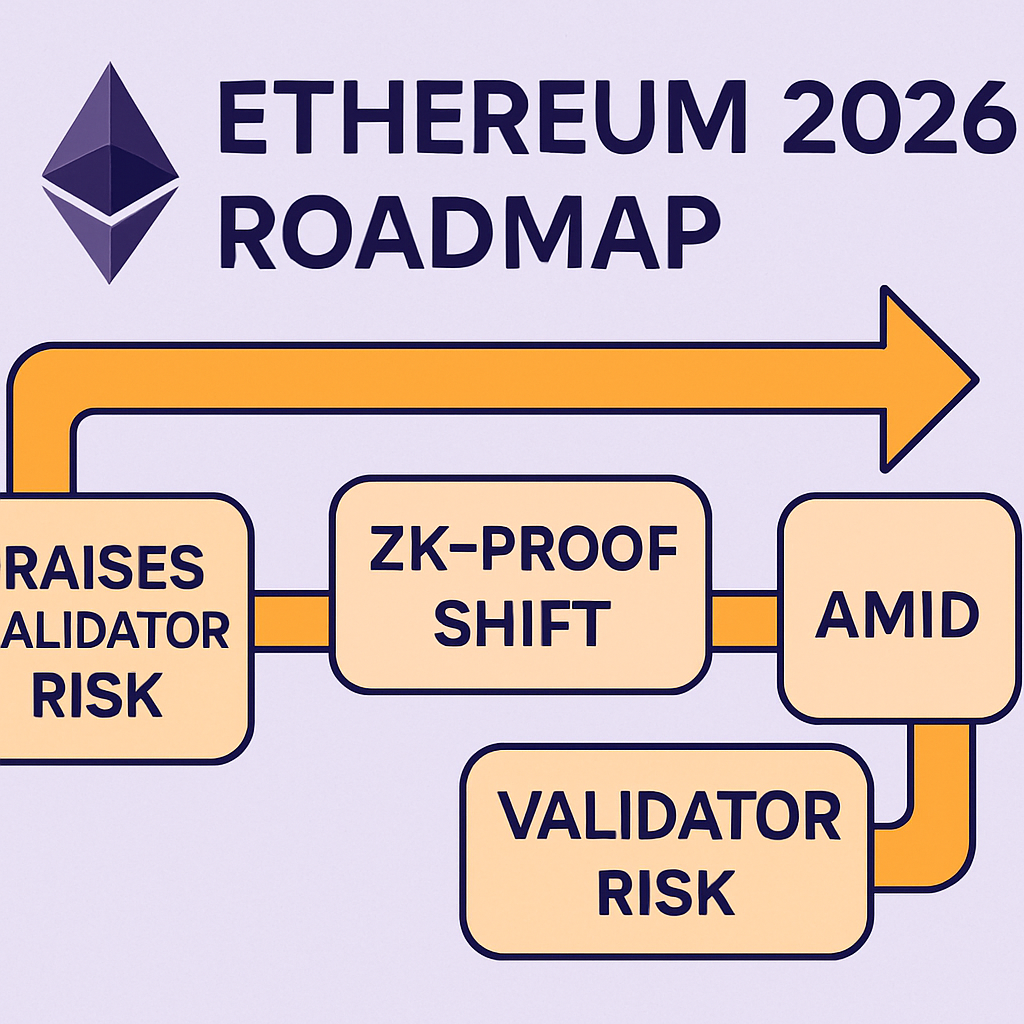
Ethereum’s 2026 upgrade strategy centers on two primary tracks: scaling rollup data availability through PeerDAS and blob parameter-only (BPO) enhancements under the Fusaka upgrade, and expanding base-layer execution capacity via significant gas limit increases managed through coordinated social consensus. Fusaka, activated Dec. 3, 2025, sets the foundation for controlled blob throughput ramps, allowing blob targets to double at measured intervals up to a maximum of 48 blobs per block, contingent on network health monitoring.
The execution track, branded “Glamsterdam,” encompasses draft EIPs such as EIP-7732 (en-shrined proposer-builder separation), EIP-7928 (Block-Level Access Lists), and EIP-7904 (repricing mismatches), aiming to improve parallelism, state update efficiency, and throughput without compromising decentralization. Practical deployment timelines span a Jan. 8–Feb. 4 proposal window for headline items, followed by community discussion and non-headliner finalization phases, culminating in the Hegota meta-EIP schedule for late-2026 considerations.
Crucially, validator operations face a paradigm shift from full block re-execution to verification of ZK-execution proofs, requiring staged adoption of ZK-enabled clients. Validator hardware must support real-time proof generation and validation without centralized prover dependencies. Research indicates potential “free option” failure modes under ePBS (EIP-7732) with 8-second option windows, projecting non-trivial percentages of blocks at risk under high volatility conditions. Network liveness under proof verification load emerges as a key risk factor, as increased gas limits and blob data drive bandwidth and storage demands.
Developers and operators must coordinate upgrades to client implementations, manage the transition of execution validation markets, and ensure sufficient proof supply without concentration risks. The roadmap’s success depends on robust testnets, inter-client interoperability for blob handling, and clear governance on parameter changes to balance throughput gains against security and decentralization imperatives. Ethereum governance milestones for 2026 anchor community alignment, but execution remains contingent on solver and validator readiness for the ZK proof frontier.
Comments (0)