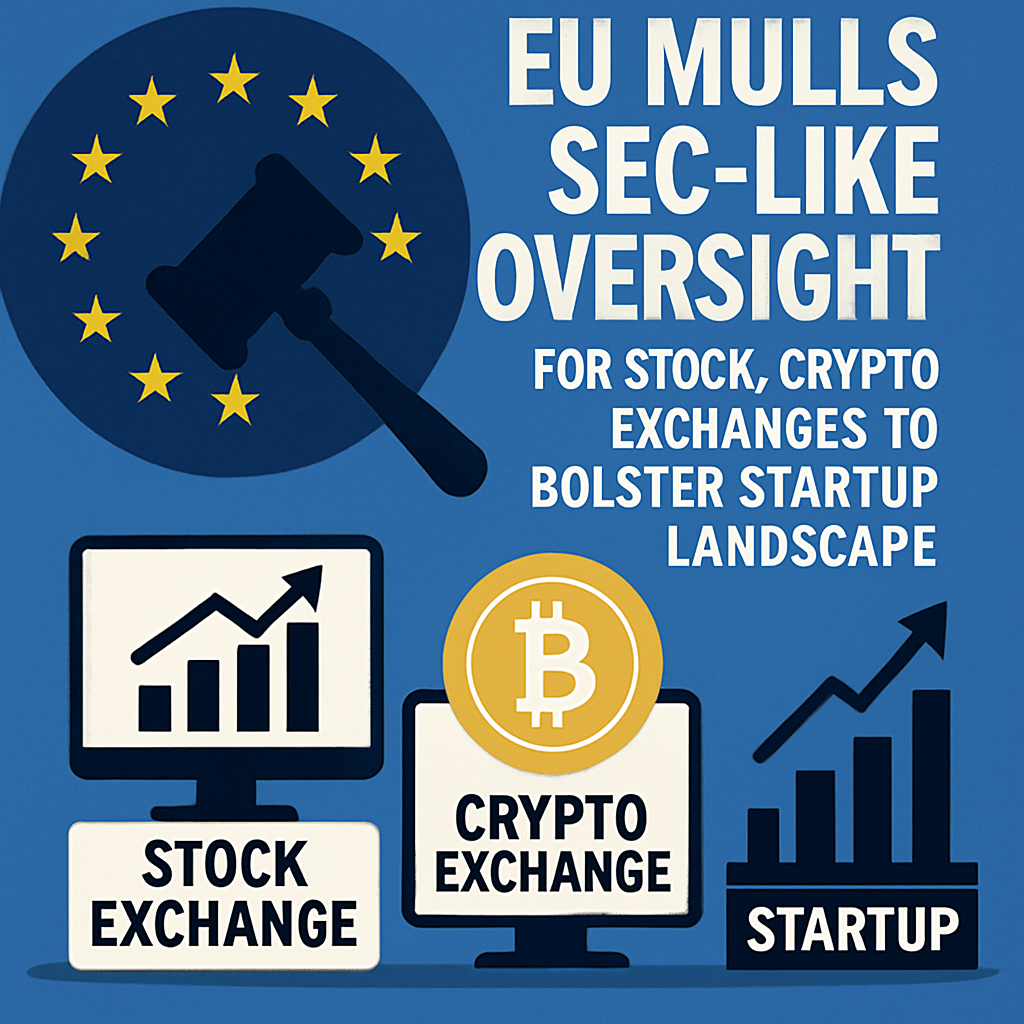
EU Mulls SEC-Like Oversight for Stock and Crypto Exchanges
A draft proposal under consideration by the European Commission aims to extend the remit of the European Securities and Markets Authority (ESMA) to include supervision of both stock and cryptocurrency exchanges. The measure is designed to address fragmentation caused by a patchwork of national regulators and to improve the bloc’s competitiveness relative to the United States.
Under the current EU regulatory landscape, member states retain authority over exchange licensing, enforcement and oversight. This has led to inconsistent rules, higher compliance costs and barriers for startups seeking to operate across borders. The draft proposal would empower ESMA with direct supervisory powers and the ability to issue binding decisions, reducing reliance on national bodies.
Rationale Behind the Proposal
Proponents argue that a unified supervisory model akin to the U.S. Securities and Exchange Commission (SEC) would strengthen investor protection, mitigate systemic risk and simplify regulatory compliance. Christine Lagarde, President of the European Central Bank, has publicly supported the concept of a “European SEC” to bolster the capital markets union and attract international investment.
Critics caution that centralization could slow decision-making and diminish the influence of smaller member states. To address these concerns, the proposal includes mechanisms for stakeholder input and a phased implementation schedule, with ESMA assuming new powers gradually over a multi-year period.
Impact on Crypto Service Providers
Crypto asset service providers (CASPs) currently operate under the Markets in Crypto-Assets Regulation (MiCA), which took effect in December 2024. MiCA grants passporting rights, allowing firms authorized in one member state to offer services EU-wide. Under the new plan, ESMA would oversee compliance, licensing and dispute resolution for all CASPs.
Industry participants expect clearer guidance on anti-money laundering measures, security requirements and a more consistent interpretation of MiCA across the bloc. This could reduce regulatory arbitrage and encourage institutional participation in crypto markets.
Next Steps and Timeline
The European Commission plans to publish a draft text in December 2025, followed by public consultation and review by the European Parliament and Council. If approved, ESMA would gradually assume supervisory functions beginning in mid-2026, with full implementation targeted for late 2027.
Stakeholders will monitor the consultation process closely, particularly for provisions relating to dispute settlement, fine-setting and the interaction with existing national frameworks. The outcome will shape the future of both traditional finance and digital asset markets in the EU.
Comments (0)