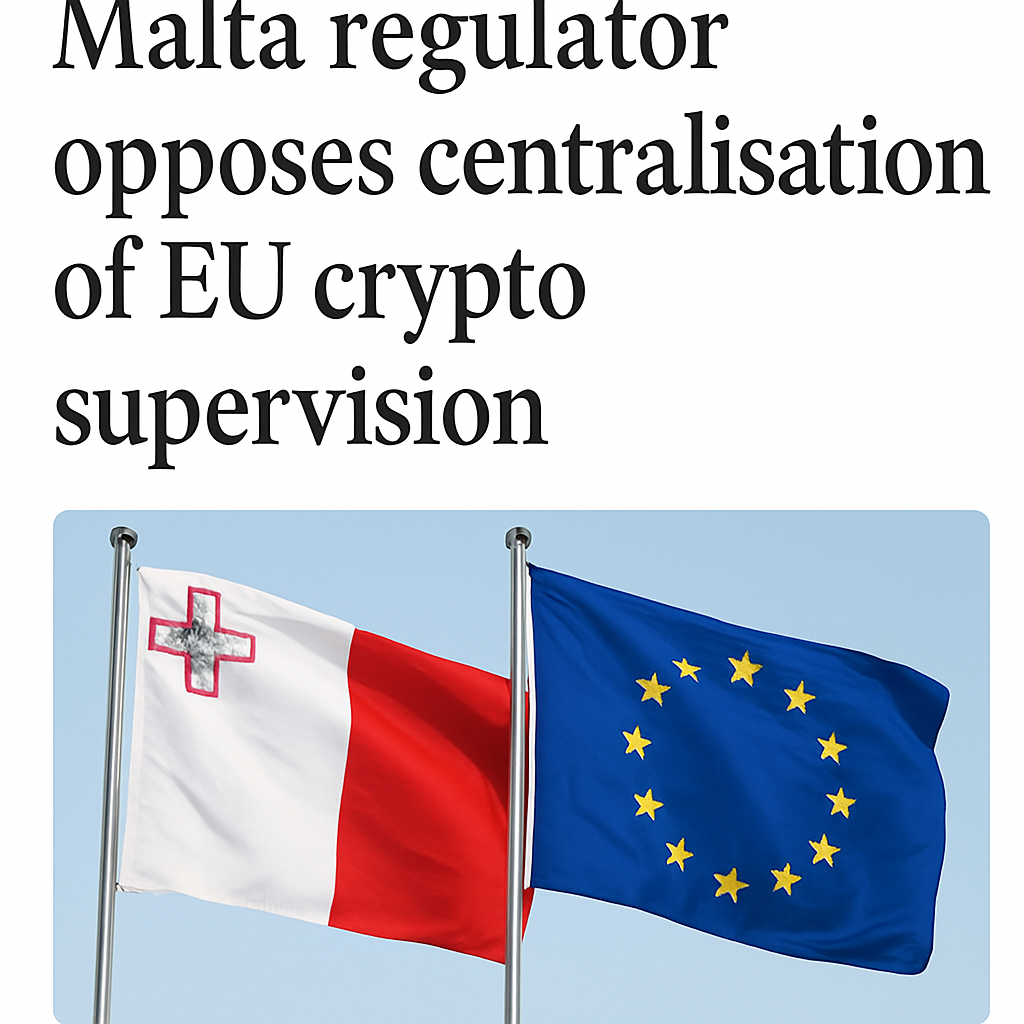
On September 16, 2025, the Malta Financial Services Authority (MFSA) publicly rejected proposals by France, Italy and Austria to centralise the supervision of major cryptocurrency firms under the European Securities and Markets Authority (ESMA). MFSA representatives stated that while supervisory convergence efforts are welcome, vesting additional authority in ESMA at this stage would introduce a redundant bureaucratic layer.
The proposal emerged amid concerns that member states apply the Markets in Crypto-Assets Regulation (MiCA) variably, leading some firms to seek licences in jurisdictions with less stringent enforcement. France’s Autorité des Marchés Financiers (AMF), Italy’s Consob and Austria’s Finanzmarktaufsicht (FMA) jointly submitted a request for ESMA to assume direct oversight of significant crypto-asset service providers operating across the European Union.
MFSA spokespersons argued that Malta’s crypto licensing process, which underwent enhanced scrutiny during the implementation of MiCA in mid-2025, already adheres to rigorous standards. They cautioned that centralising powers could impede the agility and efficiency required to foster innovation in the digital asset sector, particularly as the EU seeks to strengthen its global competitiveness in financial technology.
Analysts note that MiCA’s passporting mechanism allows firms licensed in one member state to operate throughout the EU, but disparities in national rule-books risk undermining MiCA’s harmonisation objectives. While ESMA head Verena Ross has indicated openness to expanded responsibilities, resistance from smaller member states wary of ceding jurisdiction underscores the complexity of balancing regulatory consistency with subsidiarity.
Despite the MFSA’s objections, France’s regulator has signalled willingness to challenge existing crypto licences it deems inadequately supervised. Industry stakeholders are monitoring developments closely, as any shift toward centralised oversight could reshape compliance frameworks for cross-border crypto operations and influence the strategic choices of international digital asset firms seeking EU market access.
Comments (0)