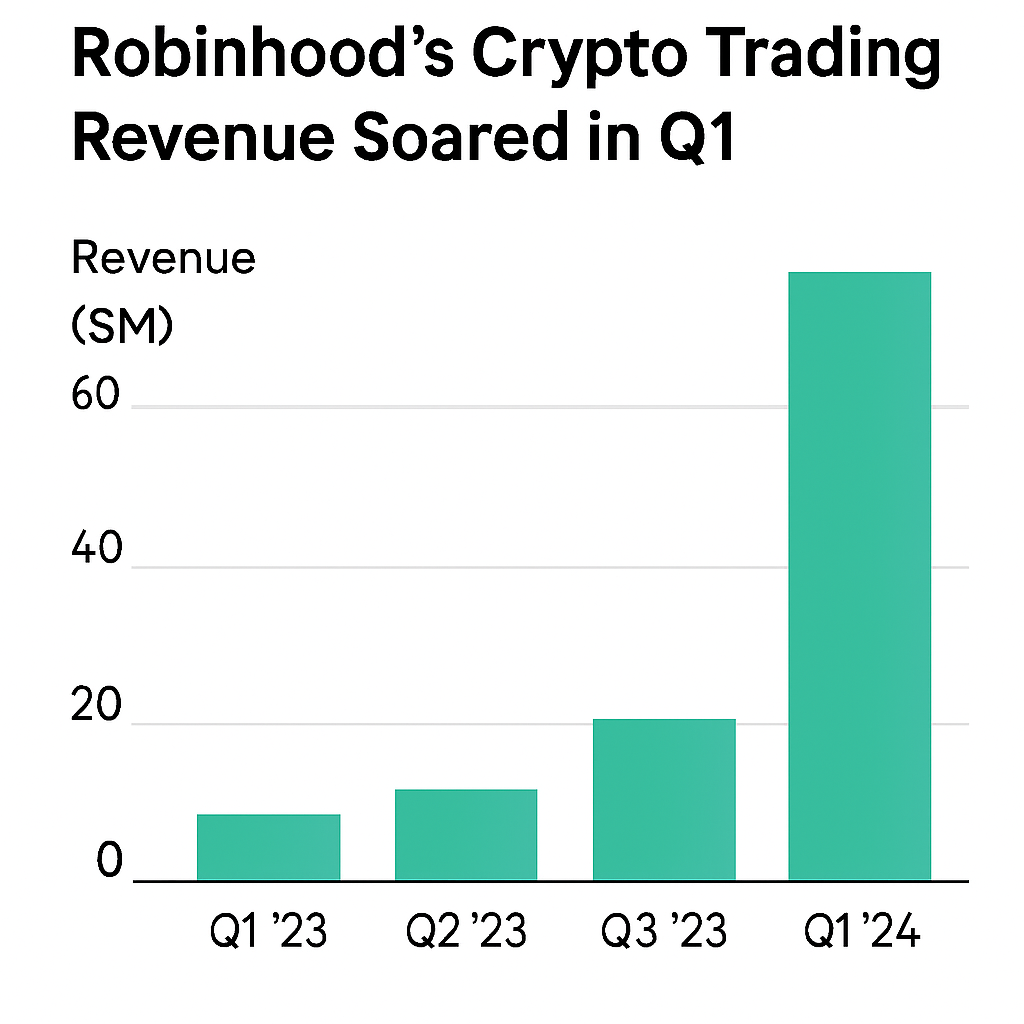
The brokerage platform reported a 339 percent year-over-year increase in third-quarter crypto trading revenue, rising from $61 million to $268 million as traders executed $80 billion in digital asset volume. Adjusted earnings per share (EPS) reached $0.61, surpassing the Street consensus of $0.53, while total net revenue amounted to $1.27 billion compared to forecasts of $1.21 billion. After-hours trading saw a 2 percent decline in the share price despite continued strength across all business lines.
Revenue diversification emerged as a key driver of performance, with the addition of two new units—prediction markets and a music-rights tokenization platform—each generating roughly $50 million in annualized revenue. The firm’s global footprint expanded through the acquisition of a regulated European exchange, broadening the user base to over 20 million active accounts. Operational leverage improved as cost of revenue declined to 47 percent of net revenue, down from 55 percent in the prior year period.
Market capitalization reached $126 billion, positioning the firm above several industry peers. Trading metrics showed an active user base growth of 45 percent year-over-year, with monthly transacting users crossing 15 million for the first time. Volatility in the broader crypto market boosted retail engagement, contributing to elevated average revenue per user of $17.80, up from $11.20 year-over-year.
Product innovation continued with the rollout of a decentralized custody offering targeting high-net-worth investors, featuring multi-signature and institutional-grade security controls. The rollout attracted $5 billion in new assets under custody within the quarter. Concurrently, a pilot of tokenized securities trading processed $120 million in notional volume, underscoring the platform’s capability to support regulated digital asset products.
Liquidity and margin balances reached record highs, with average overnight margin balances of $4.2 billion reflecting strong customer engagement in leveraged products. Risk management measures, including real-time monitoring and dynamic margin requirements, helped maintain a default rate below 0.02 percent. Regulatory engagement intensified as the firm secured in-principle approval for a crypto custody license in two additional jurisdictions.
Liquidity metrics improved with a 30 percent reduction in transaction processing times, driven by infrastructure enhancements and regional data-center expansion. System uptime remained above 99.98 percent, reflecting investments in resilience and capacity planning. Technology initiatives included integration of on-chain analytics for real-time fraud detection and a proprietary order-routing algorithm to optimize execution costs.
Leadership commentary highlighted a strong start to Q4, citing October trading volumes above seasonal norms and product usage metrics exceeding internal forecasts. Capital allocation priorities include continued investment in market-making operations, expansion of prediction-market offerings, and research into programmable stablecoin products. Long-term targets emphasize 25 percent organic revenue growth alongside maintained profitability margins above 35 percent.
Comments (0)