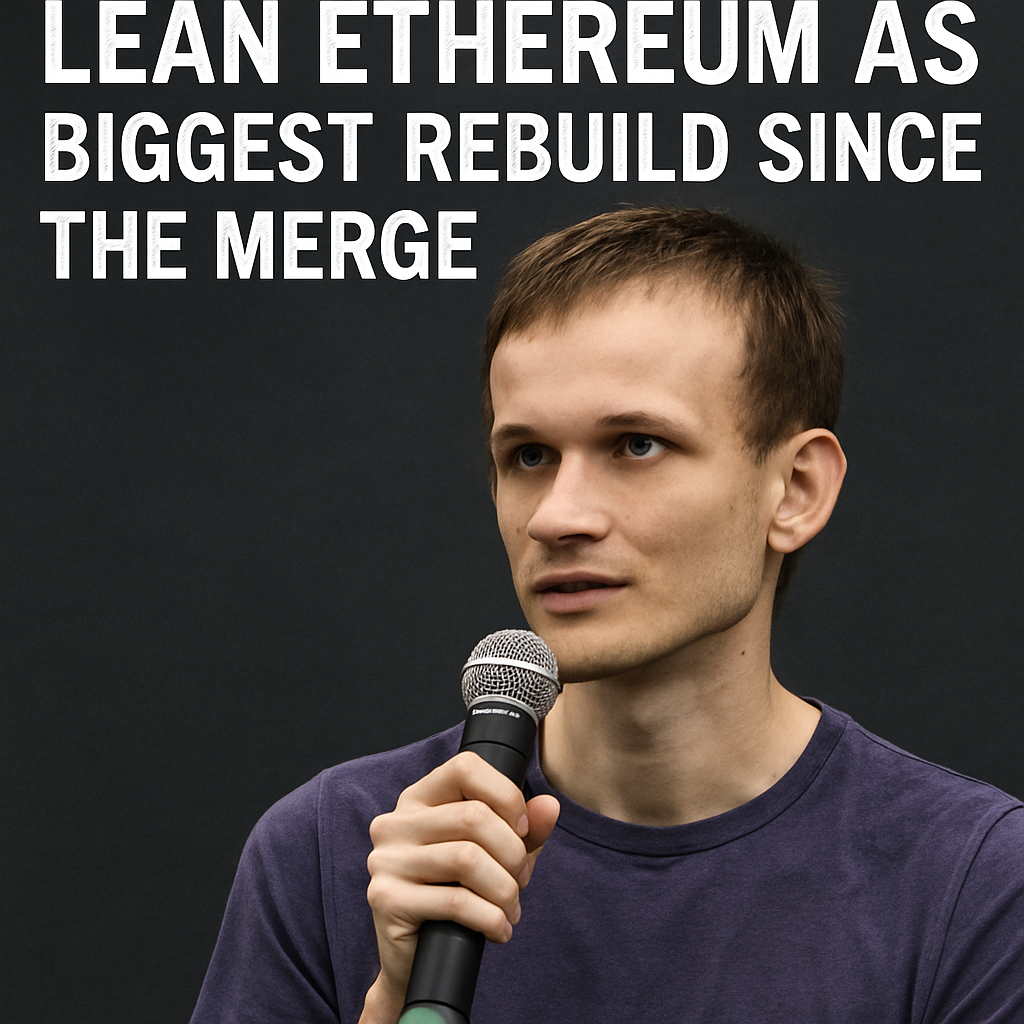
Ethereum co-founder Vitalik Buterin presented an updated technical roadmap for “Lean Ethereum” at 07:44 UTC on July 6, 2026, calling it the network’s largest protocol overhaul since the 2022 Merge. The Lean Ethereum initiative, first proposed in July 2025, seeks to rebuild nearly every major component of the Ethereum stack over a three- to four-year horizon while maintaining continuity for existing smart contracts and decentralized applications.
Buterin’s updated “strawmap” emphasizes two newly prioritized design goals: quantum resistance and first-class privacy. To address potential future threats from quantum computing, the roadmap schedules the systematic replacement of all cryptographic primitives vulnerable to quantum attacks with quantum-safe alternatives. The plan also redefines core data-storage schemes to enable privacy-preserving, intermediary-free transactions natively at the protocol level, rather than as optional layers.
Under Lean Ethereum, the existing flexible “dynamic” global state—currently stored and maintained by every full node—would be capped in growth to prevent unsustainable data bloat. Concurrently, Ethereum would support new, more parsimonious state models optimized for light-client verification, enabling nodes to synchronize and validate blocks with minimal local storage. This bifurcation aims to balance decentralization against long-term scalability.
The protocol’s execution and consensus layers will transition toward recursive STARK-based proofs to replace full replay verification by individual nodes. Recursive proofs allow compact verification of large transaction batches, reducing computational demands and improving throughput. Over successive network upgrades—starting with Glamsterdam and followed by Hegotá—Ethereum’s transaction capacity, data limits, and finality thresholds will be steadily enhanced, gradually migrating validation burdens off-chain.
Buterin also signaled that the Ethereum Virtual Machine (EVM) may eventually be supplanted by a simpler, RISC-V–style execution engine, with the EVM retained as a compatibility layer. Such a shift could further streamline protocol logic and enable formal verification of smart contracts against a leaner core.
The Lean Ethereum vision underlines a commitment to robust security and privacy well ahead of widespread demand for these features. By embedding quantum-safe and privacy-focused design into the protocol’s DNA, Ethereum aims to sustain its role as a foundational, trustless settlement layer for the next decade of blockchain innovation.
Comments (0)